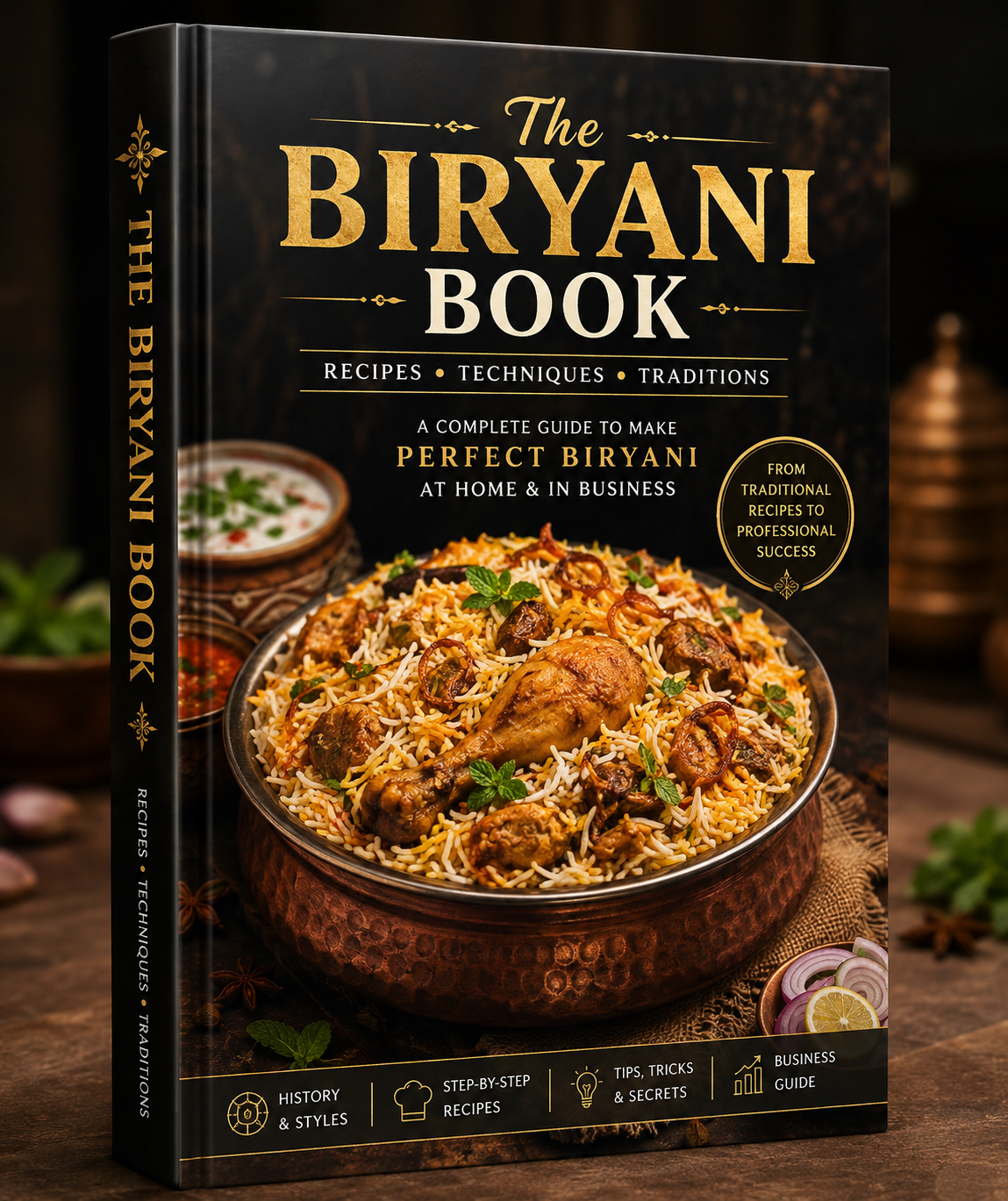
Page 1 — Introduction to The Biryani Book
The Biryani Book is a detailed and practical guide created for people who want to understand biryani from the basics to the finished plate. Biryani is one of the most loved rice dishes in India and has developed into countless regional and family variations. Although the basic ingredients may appear simple—rice, spices, meat or vegetables, herbs and fat—the final result depends on how carefully each ingredient is selected, prepared and cooked.
This book takes the reader beyond simply following a recipe. It explains the reasoning behind the cooking process: why one type of rice works better for a particular style, why marination matters, how spices should be balanced, why the rice must be stopped before it is completely cooked, and how dum cooking brings the entire dish together.
The purpose of this book is to make biryani easier to understand. A beginner should be able to read it and start cooking with confidence. At the same time, someone who already prepares biryani should find useful ideas for improving consistency, texture, aroma and presentation.
The book also recognizes that biryani is no longer limited to home kitchens and traditional restaurants. It has become a major food-business product, especially through cloud kitchens, delivery platforms, catering services, takeaway counters and small food brands. For that reason, the book includes practical business concepts such as standardization, portion control, food costing, menu planning, packaging and production consistency.
Throughout the book, the emphasis is on a simple principle: good biryani comes from understanding the process, not from blindly following a recipe.
When the reader understands the relationship between rice, moisture, seasoning, protein, aromatics and heat, it becomes much easier to make changes without losing the identity of the dish.
This is why The Biryani Book is designed as both a cooking guide and a practical introduction to the thinking behind biryani.
Page 2 — The Story Behind Biryani
Biryani has a long and layered culinary history. Different regions and communities have developed their own versions over many generations, making it difficult to describe biryani as one single recipe.
Rice-and-meat preparations have existed in different parts of the world for centuries. Over time, culinary traditions from Persia, Central Asia and South Asia interacted with local ingredients, cooking methods and regional preferences. Royal kitchens, trading communities, military kitchens, travelling cooks and households all contributed to the development of dishes that eventually became recognizable forms of biryani.
The influence of royal kitchens was especially significant because these kitchens brought together skilled cooks, high-quality ingredients and elaborate cooking techniques. Rice was prepared with aromatic spices, meat was carefully seasoned, and ingredients such as ghee, saffron, dried fruits, nuts and herbs were used to create rich and fragrant dishes.
However, biryani did not remain a food associated only with courts and wealthy households. Over time, it entered everyday food culture. Cities developed their own styles, restaurants created signature recipes, families passed down recipes through generations, and biryani became closely associated with weddings, festivals, celebrations and large gatherings.
Migration played another important role. When people moved from one region to another, they carried their food traditions with them. Ingredients were changed according to local availability, rice varieties were replaced, spice levels were adjusted, and new accompaniments were introduced.
This is one reason why biryani is so diverse today.
A Hyderabadi biryani can taste very different from a Kolkata biryani. A Malabar biryani can have a completely different rice texture from a Lucknowi biryani. Yet all of them belong to the wider family of dishes built around aromatic rice, seasoned ingredients and careful cooking.
Understanding this history helps the reader appreciate why there is no single answer to the question, “What is the correct biryani?”
There are traditions, techniques and regional identities. The goal of this book is to help readers understand those differences rather than treating them as mistakes.
Page 3 — Understanding Regional Biryani Styles
One of the most interesting parts of biryani culture is the variety of regional styles.
Hyderabadi biryani is one of the most famous varieties. It is generally recognized for its strong aroma, flavorful masala, fried onions, mint, coriander and characteristic dum cooking. Kacchi-style Hyderabadi biryani uses marinated raw meat that cooks together with partly cooked rice during the final stage.
Lucknowi or Awadhi biryani is often associated with a more refined and delicate flavor profile. The focus is frequently placed on aroma and the natural flavor of the meat and rice rather than extreme heat. Saffron, whole spices and carefully prepared stock or meat can play an important role.
Kolkata biryani has a distinctive identity. It often uses a lighter spice profile and is especially famous for the inclusion of potato. This shows how regional food culture can completely transform a dish while still preserving its basic character.
Malabar and Thalassery biryani reflect the food traditions of Kerala. Short-grain aromatic rice such as kaima or jeerakasala is important in these styles. Ghee, fried onions, nuts, raisins, herbs and regional spices contribute to their unique character.
Ambur and Dindigul biryani represent important South Indian traditions. Seeraga samba or related rice varieties are often associated with their preparation, and the spice balance, acidity and meat preparation create a very different eating experience from a basmati-based northern style.
There are also many other regional and restaurant-specific versions.
The reader should understand that these differences are not simply differences in spice quantity. They can include:
- Rice variety
- Meat preparation
- Marination technique
- Onion treatment
- Spice combinations
- Acidity
- Cooking method
- Dum time
- Fat level
- Garnishes
- Accompaniments
This is why a person who wants to make good biryani should first decide what style they are trying to create.
A common mistake is combining elements from several styles without understanding how the changes affect cooking. Changing the rice, for example, may require changing the water ratio, cooking stage and dum time.
Regional identity gives the cook a starting framework.
Page 4 — Choosing the Right Rice
Rice is the foundation of biryani.
Even an excellent masala cannot completely compensate for poorly cooked rice. The grains need to remain recognizable, separate and aromatic while still absorbing enough flavor from the masala.
For many North Indian and Hyderabad-style preparations, basmati rice is a popular choice. Aged basmati can produce long, aromatic grains when cooked correctly. However, the quality of the particular rice matters. Broken grains, inconsistent grain size and differences in age can affect the final result.
South Indian styles often use other varieties. Kaima or jeerakasala rice, for example, has a shorter grain and a distinct aroma. It creates a completely different texture from basmati, which is one reason it is important for certain regional traditions.
The book explains that readers should not simply ask, “Which rice is the best?”
The better question is:
Which rice is best for the biryani style I am trying to make?
Rice preparation also requires attention.
The grains should generally be washed gently to remove excess surface starch. Soaking can help the grains hydrate evenly, but the correct soaking time depends on the variety.
The rice is usually cooked in plenty of seasoned water before layering. Salt is particularly important. If the rice water tastes bland, the finished grains will often taste bland as well.
The most important point is the half-cooked stage.
The rice should not be fully cooked before the final dum. It needs to be tender on the outside while still retaining some firmness in the center.
This allows steam and heat during dum cooking to complete the grain without making it mushy.
The book therefore encourages readers to taste rice instead of depending entirely on a fixed cooking time.
Every kitchen is different.
Rice brand, soaking period, water temperature, pot size, stove power and quantity can all affect cooking time.
Learning to recognize the correct grain texture is a much more valuable skill than memorizing one number of minutes.
Page 5 — Spices, Aromatics and Flavor
Spices are one of the most misunderstood parts of biryani.
Many people assume that using more spices automatically creates better flavor. In reality, too many spices can make the dish heavy, confusing and bitter.
A good biryani has layers of aroma.
Whole spices such as cinnamon, cardamom, cloves, bay leaf, star anise, black cardamom and mace can create a deep aromatic foundation.
Ground spices such as chili, coriander, cumin and turmeric contribute body, color and heat.
Fresh aromatics such as ginger, garlic, green chili, mint, coriander and onion provide freshness and character that dry spices cannot produce by themselves.
The book explains the importance of combining these systems instead of relying on one.
Onion is particularly important.
Fried onions add sweetness, roasted flavor, texture and color. They are one of the most recognizable elements in many biryani styles.
However, fried onions must be prepared carefully. If they are undercooked, they may lack sweetness and depth. If they are burned, bitterness can spread throughout the entire dish.
Fresh herbs are equally important.
Mint contributes a cooling aromatic quality, while coriander provides a fresh green character. These herbs help prevent a rich biryani from becoming too heavy.
Yogurt and lemon introduce acidity.
Acidity is essential because it balances fat and spice. Without enough acidity, rich biryani can taste dull. Too much acidity, however, can make the dish sharp and unpleasant.
Saffron, kewra or rose water may be used as finishing aromas in suitable styles. These should be added carefully because their job is to provide subtle fragrance rather than dominate the dish.
The most important principle is balance.
A good biryani should smell complex and inviting.
The reader should be able to notice several different aromas instead of smelling only chili, only cardamom or only fried onion.
Page 6 — Creating the Perfect Masala
The masala is the heart of the biryani.
The rice provides structure, but the masala provides the main savory character.
A practical masala may contain onions, ginger, garlic, green chili, yogurt, mint, coriander and a combination of whole and ground spices.
The exact proportions depend on the regional style and type of protein.
The book explains that masala preparation should be treated as a sequence rather than a single step.
First, the fat is heated.
Whole spices are introduced so their aroma can bloom.
Onions are then cooked carefully.
Ginger and garlic are added to create the base pungency.
Green chilies and ground spices are incorporated.
Yogurt can then be mixed in carefully, followed by herbs and other seasoning.
The masala should eventually lose excessive moisture and develop a concentrated flavor.
This concentration matters because the masala will later be distributed through a much larger quantity of rice.
A masala that tastes only mildly seasoned before layering may produce a bland biryani after the rice is added.
Salt also needs special attention.
The book encourages seasoning the major components separately:
- Protein marinade
- Masala
- Rice water
This creates much better distribution than adding all the salt at one stage.
The book also explains how this approach becomes important when cooking for a business.
A home cook may use “one spoon” or “a little” of an ingredient.
A professional kitchen cannot depend on vague measurements.
For commercial production, ingredients should be weighed.
If one cook uses 90 grams of onion while another uses 130 grams, the flavor of the finished batch may change.
Standardization is therefore not only a business concept.
It is also a cooking-quality concept.
Page 7 — Marination and Protein Preparation
Marination prepares the protein before it enters the cooking process.
Chicken, mutton and other proteins require different treatment.
Chicken generally needs less marination time than tougher red meat. A few hours of refrigeration can be enough to distribute flavor throughout the surface.
Mutton or goat requires greater attention to cut, connective tissue and cooking time. Marination can add flavor, but tender meat ultimately depends on controlled cooking.
A practical marinade may include:
- Thick yogurt
- Ginger-garlic paste
- Green chili
- Chili powder
- Turmeric
- Salt
- Lemon juice
- Mint
- Coriander
- Biryani spices
The book explains how these ingredients work together.
Yogurt helps the masala cling to the protein and contributes acidity.
Ginger and garlic add pungency.
Chili creates heat and color.
Herbs provide freshness.
Lemon adds brightness.
Oil or ghee can help carry aromatic compounds.
However, excessive marination is not automatically better.
Too much yogurt can increase moisture. Too much lemon can make the flavor overly sharp. Too much salt can affect the texture of the protein.
The book also emphasizes refrigeration and safe handling of raw meat.
Good cooking begins with good food-handling practices.
The final lesson of the marination chapter is that marination should support the protein rather than completely hide it.
The meat should remain recognizable and juicy while carrying the flavor of the surrounding masala.
Page 8 — Rice Cooking and the Half-Cooked Stage
For many biryani techniques, the rice is partly cooked before final layering.
This stage is where many beginners make their biggest mistake.
If the rice is cooked too far, the final biryani can become soft or mushy.
If the rice is too raw, the final dum stage may not provide enough moisture and heat to finish it properly.
The book therefore focuses heavily on observation.
First, plenty of water is brought to a boil.
Salt and selected whole spices are added.
Soaked rice is introduced carefully.
The rice is stirred gently during the early cooking stage.
Then comes the most important part: tasting.
The grain should be partly cooked.
The outer portion should feel tender.
The center should still have some resistance.
It should not taste raw, but it should clearly not be at its final eating texture.
Once the rice reaches the desired stage, it needs to be drained immediately.
Leaving it in the hot water can continue cooking the grain.
The book also explains that different rice varieties require different treatment.
A basmati recipe cannot simply be transferred to kaima rice without adjustment.
The same is true for different brands of the same rice.
The practical lesson is simple:
Learn the grain, not just the clock.
Once you can identify the correct stage by sight, touch and taste, your biryani becomes much more consistent.
Page 9 — Layering and Dum Cooking
Layering is where the individual components begin to become one dish.
The basic idea is to combine the prepared masala or meat with partly cooked rice while adding herbs, fried onions, ghee and selected finishing aromas between the layers.
The bottom of the pot should have enough moisture to prevent scorching but not so much liquid that the rice becomes wet.
The rice is spread evenly rather than packed tightly.
Herbs and fried onions are distributed across the surface.
Saffron milk may be added in appropriate preparations.
A small amount of ghee can contribute aroma and richness.
Then the pot is sealed.
This is the beginning of dum cooking.
The goal of dum is controlled steam.
The sealed environment allows the rice to finish cooking while the aroma circulates within the pot.
High heat is generally not required throughout the process.
Instead, the cook uses enough heat to build steam and then reduces the temperature.
A heavy-bottomed pot can help distribute heat more evenly.
A tawa or heat diffuser can also be useful when working with a thin cooking vessel.
One of the most important lessons is to avoid repeatedly opening the pot.
Every time the lid is opened, steam escapes.
That changes the internal environment.
After the cooking stage, the biryani should be allowed to rest.
Resting gives the moisture and heat time to redistribute.
When the lid is opened, the first experience should be the aroma.
Then the rice should be loosened gently from the sides and bottom.
The goal is not to aggressively mix the pot into one homogeneous mass.
Biryani should retain its layered character while still providing balanced portions.
Page 10 — Chicken Biryani: Practical Recipe
The book includes a practical chicken biryani method designed for approximately four to five servings.
A typical ingredient base includes chicken, basmati rice, onions, yogurt, ginger-garlic paste, green chilies, mint, coriander, lemon, whole spices, ground spices and ghee or oil.
The first stage is marination.
The chicken is combined with yogurt, ginger-garlic paste, chili, salt, herbs, lemon and spices.
It should be refrigerated while the flavors develop.
The second stage is preparing the onions.
Sliced onions are fried until golden and crisp, then drained.
The third stage is the rice.
Soaked basmati rice is cooked in heavily seasoned water until partly done.
It is drained immediately.
The chicken masala is then prepared.
The chicken should be cooked carefully so it develops flavor while retaining sufficient moisture.
The exact method can vary depending on whether the cook wants a cooked-meat layering method or a more traditional raw-meat dum technique.
The rice is then layered over the chicken.
Fried onions, mint, coriander, saffron milk and ghee may be added.
The pot is sealed and finished over controlled heat.
After resting, the biryani is opened and served carefully.
The book also provides a quality checklist.
The finished biryani should ideally have:
Separate grains: Rice should not be a sticky mass.
Tender chicken: Meat should be properly cooked and pleasant to eat.
Balanced seasoning: Salt and spice should be noticeable without becoming aggressive.
Controlled moisture: The bottom should not be watery.
Aromatic finish: The fragrance should be clear when the pot is opened.
This recipe is presented not as an unchangeable formula but as a practical foundation that can be adjusted according to regional preference.
Page 11 — Vegetarian Biryani
Vegetarian biryani deserves its own approach.
Vegetables behave differently from meat.
They contain different amounts of water and require different cooking times.
If vegetables are thrown into a masala without considering these differences, the final biryani may become watery or unevenly cooked.
The book recommends selecting vegetables carefully.
Carrot, beans, peas, potato, cauliflower, bell pepper and paneer can all work well.
Vegetables can be cut to compatible sizes or added at different stages based on how quickly they cook.
Moisture control is especially important.
The vegetable masala should be cooked until excess water reduces before the rice is added.
This allows the masala to cling to the vegetables rather than creating a watery base.
For additional richness, the book discusses fried onions, cashews, raisins, mint, coriander, saffron and ghee.
For a lighter everyday version, the cook can reduce the fat and focus more strongly on fresh herbs, lemon and carefully balanced spices.
Paneer can be included as a premium ingredient.
It should not be overcooked because excessive heat can make it firm and rubbery.
The book emphasizes that vegetarian biryani should not simply feel like “chicken biryani without chicken.”
Vegetables should remain identifiable.
The rice should remain separate.
The masala should have enough depth to create a satisfying meal.
The final dish should feel complete in its own right.
This makes vegetarian biryani suitable for home meals, family gatherings, catering and food businesses serving customers who prefer meat-free products.
Page 12 — Serving, Sides and Troubleshooting
A great biryani meal is usually more than the main pot.
Raita provides cooling contrast.
Onion and lemon provide freshness and acidity.
Salan provides a spicy and tangy sauce.
Mint and coriander add fresh aroma.
The book explains why these accompaniments work.
Biryani is a relatively rich food.
Acidity and coolness help balance that richness.
A simple cucumber raita can be made by combining thick yogurt with cucumber, roasted cumin, salt, mint and coriander.
For a more traditional meal, a spicy nut-and-seed salan can provide a strong contrast.
Serving temperature is also important.
Biryani should be warm enough to release aroma without being so hot that flavor becomes difficult to appreciate.
The book then moves into troubleshooting.
Mushy rice can result from overcooking, excess liquid or excessive dum time.
Hard rice can result from insufficient pre-cooking or insufficient steam.
Burnt rice at the bottom can result from a thin vessel or excessive direct heat.
Bland biryani often means the rice water or masala was not seasoned enough.
Excessive spice can occur when chili and whole spices are both used aggressively.
Too much oil can make the dish feel heavy and hide the aroma.
Undercooked chicken requires immediate attention because food safety is more important than maintaining a planned cooking schedule.
The troubleshooting section encourages readers to identify the earliest point at which the recipe went wrong.
Fixing the root cause is more effective than trying to rescue the final dish after every stage has already been completed.
Page 13 — Biryani as a Food Business
Biryani has strong potential as a food-business product because it is familiar, filling, customizable and suitable for takeaway and delivery.
A small business can operate in several formats:
- Cloud kitchen
- Takeaway counter
- Catering service
- Home-based food business
- Food stall
- Restaurant
- Party and event supply
The book explains that the first step is not to create a huge menu.
It is to create one strong product.
A signature chicken biryani can become the main product.
A premium meat option can attract higher-value customers.
A vegetarian biryani can serve a different customer group.
Raita, salan, dessert and beverages can increase order value.
Standardization is critical.
A commercial recipe should specify:
- Rice quantity
- Protein quantity
- Marinade quantity
- Spice weights
- Masala yield
- Cooking time
- Portion size
- Packaging size
- Resting time
The goal is repeatability.
Customers should receive the same product whether they order on Monday afternoon or Sunday evening.
The book also introduces the idea of food costing.
The business must consider more than just rice and meat.
Packaging, labor, kitchen costs, utilities, delivery fees, wastage and marketing all affect profitability.
A product can have good sales and still lose money if these costs are ignored.
Packaging deserves special attention because biryani continues to release steam after cooking.
Poor packaging can create condensation and soften the rice.
Therefore, packaging should be tested as part of product development.
The business section encourages the reader to think like both a cook and an operator.
Page 14 — Biryani Costing, Pricing and Menu Planning
Once the recipe is standardized, the next step is understanding the economics.
The first calculation is the batch food cost.
Every ingredient should be recorded.
For example:
Rice quantity
Chicken or mutton quantity
Onions
Oil
Ghee
Yogurt
Herbs
Spices
Lemon
Saffron
Nuts
Packaging
The purchase price of each ingredient should be converted into a cost for the quantity actually used.
The next step is yield.
A batch may begin with a certain amount of raw ingredients but end with a different cooked weight.
That cooked weight should be measured.
If the finished batch produces ten saleable portions, the total production cost can be divided across those portions.
However, food cost alone does not determine the correct selling price.
The business may also need to account for:
Kitchen rent
Labor
Gas or electricity
Cleaning
Packaging
Delivery commissions
Payment processing
Marketing
Wastage
Equipment
Taxes and other operating expenses
The book recommends keeping the menu focused.
A small menu allows better inventory control and reduces complexity.
An example starter menu could include:
Signature Chicken Biryani
Premium Mutton Biryani
Vegetarian Biryani
Family Pack
Raita
Salan
Dessert or beverage
Different portion sizes can create additional price points.
Regular, large and family portions can serve different customer needs without requiring completely different recipes.
The business should also track wastage.
If too much rice remains at the end of the day, the production forecast may need adjustment.
If herbs or onions are consistently thrown away, purchasing quantities should be reviewed.
The book encourages restaurant owners and aspiring entrepreneurs to maintain a daily production sheet.
This can record batch number, ingredients, final yield, portions sold, wastage, customer feedback and complaints.
That information becomes valuable over time because it transforms intuition into data.
Page 15 — The Complete Biryani Philosophy
The final chapter brings the entire book together.
A successful biryani does not depend on one magical ingredient.
It comes from many small decisions being correct at the same time.
The rice must be suitable.
The protein must be properly prepared.
The masala must be balanced.
The salt must be distributed.
The moisture must be controlled.
The heat must be managed.
The steam must be preserved.
The final resting period must not be rushed.
The serving process must protect the texture.
The first rule is simple:
Choose the rice according to the style.
The second rule is:
Season every major component.
The third rule is:
Stop the rice before it reaches its final texture.
The fourth rule is:
Use controlled heat during dum.
The fifth rule is:
Rest before serving.
For a food business, there are additional rules.
Measure ingredients.
Record batch results.
Control portions.
Track costs.
Test packaging.
Monitor wastage.
Listen to customers.
Repeat what works.
The biggest lesson of The Biryani Book is that biryani is both an art and a system.
The art comes from aroma, regional character, personal taste and presentation.
The system comes from measurements, timing, temperature, moisture and consistency.
A home cook can use the system to become more confident.
An aspiring entrepreneur can use it to create a repeatable product.
A food lover can use it to understand why different regional biryanis taste the way they do.
There is no single “perfect” biryani for everyone.
Some people prefer intense spice.
Others prefer delicate aroma.
Some prefer long basmati grains.
Others prefer short aromatic rice.
Some want tender chicken.
Others want rich mutton.
Some want a traditional recipe.
Others want a modern interpretation.
The important thing is to understand what you are trying to achieve.
Once you understand the principles, you can make thoughtful changes without losing control of the dish.
That is the real purpose of this book.
The Biryani Book is not only about making one pot of biryani. It is about learning how to understand, prepare, improve and eventually reproduce a biryani that people will remember.
From a home kitchen to a cloud kitchen, from a family recipe to a commercial brand, the same foundation remains:
Choose good ingredients.
Respect the rice.
Balance the spices.
Control the moisture.
Manage the heat.
Give the food time.
Taste, record and improve.
And above all:
Never rush the dum.



Reviews
There are no reviews yet.